”We don’t have a pulse on what’s happening in our change-portfolio,” admitted the Managing Director of an Asset & Wealth Management company, his frustration palpable. I probed further, “Is it a problem with data, tools, or skills?” He sighed, “We have an army of people producing reports daily, drowning us in PowerPoint decks for monthly steering committees and quarterly board meetings.” Just as I was about to delve deeper, he interrupted, “That’s exactly what you need to uncover”.
-- my conversations with the client
Managing Value – a complex challenge
The problem of poor or unsatisfactory strategic portfolio outcomes, sustained long after the programme closes, is a persistent issue to solve in many organisations. Despite years of experience, expertise bought from auditors & consultants and huge sums of money spent on sophisticated tools and technologies, the challenge remains unresolved
On one hand, there is a push to measure & produce more and more reports to meet the demands of different stakeholders across the hierarchy. On the other, there is a severe lack of high-quality data to support decision making and optimise the current state or plan for the future (call it change or transformation for the future).
Compounding this, the process of gathering, cleaning, summarising, reporting, and acting upon the data is time-consuming and prone to errors, leading to “decision latency and poor dependency management” – two critical challenges that contribute to strategic programme failures across industries.
Despite the recognition of the challenge, abundance of talent, data and governance structures in many organisations, and the availability of tools to generate reports, there is a significant lack of agreement on
- what “value” means (for an organisation in its own context) and
- what to be measured & how to validate that the "value" is sustained beyond the delivery.
When the Managing Director mentioned being “drowned in PowerPoint decks,” he wasn’t just speaking for himself. Many organisations experience this data overload, producing numerous reports but deprived of the high-quality data needed for effective decision-making.
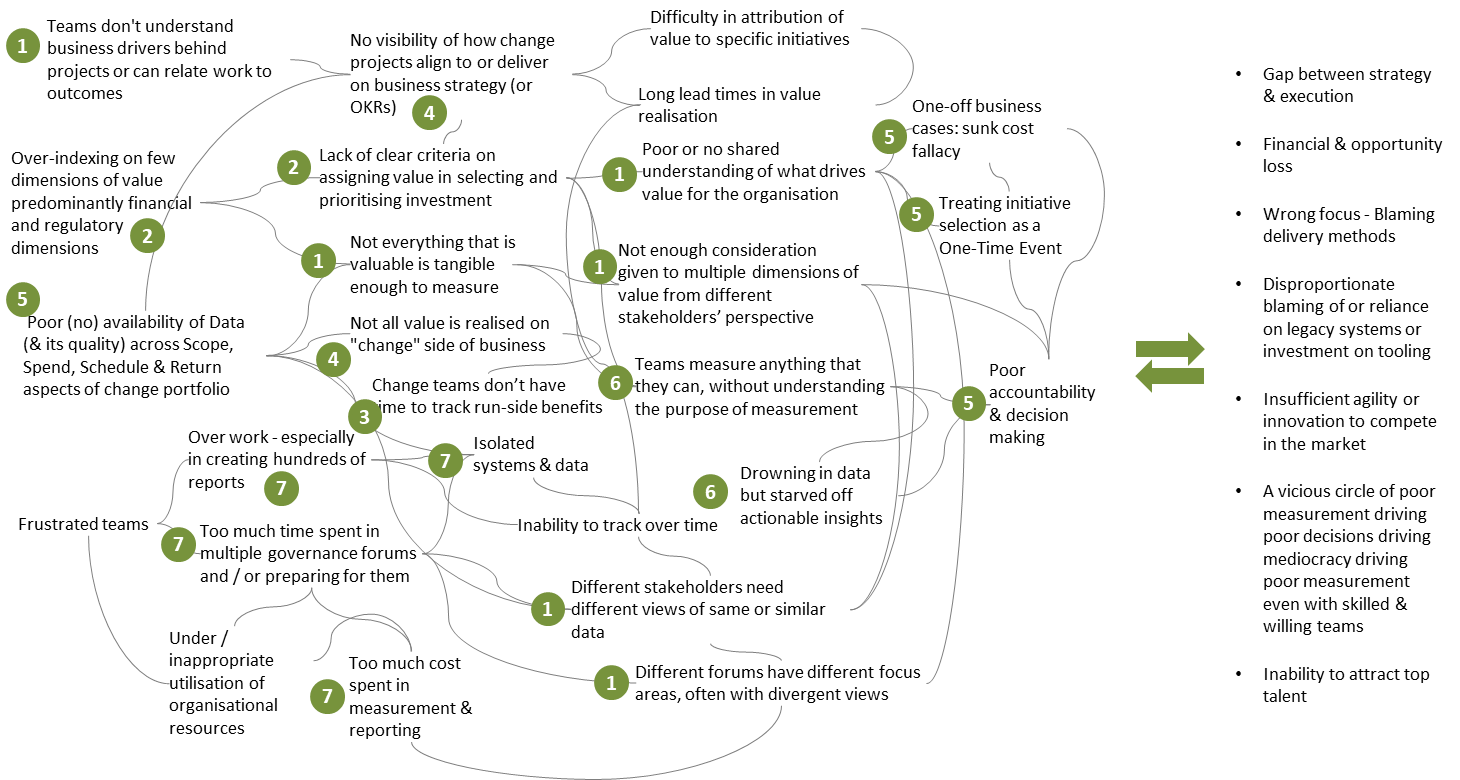
The challenge is not about delivery methods, organisational design, data collection, reporting, or governance. It runs deeper. The causal loop below shows what organisations are actually up against when they try to manage value — both at enterprise level and within the change portfolio.

Remember the Managing Director’s initial comment?—”We don’t have a pulse on what’s happening in our change-portfolio.” The challenges outlined above in the picture explain why.
The curious conclusion here is "it is not actually a portfolio management problem but of an organisational value management problem".
This is much more complex, i.e. it is difficult to establish exact cause and effect relationships, where everything seems muddled and foggy, losing the pulse.
From symptoms to root causes
But what keeps the loop spinning? In my experience across multiple organisations, two root causes sit underneath all of this.
The first is a terminology challenge. The language used to describe strategy is poorly understood and inconsistently used across the organisation. "Outcome" means one thing to the strategy team, another to finance, and something else entirely to the delivery lead. "Benefit", "impact", "value", "result" are used interchangeably or contradictorily. Even the word "Value" is used many different ways. This itself requires another article
The second is a translation challenge. Even when the words are agreed, the mechanism for turning a five or ten-year strategy into meaningful activity in the next year or two is weak or missing. Most organisations don't have a reliable way of connecting strategy with execution. The strategy document sits in one world. The project portfolio sits in another. Value realisation during and / or after the change initiative is complete is elusive or poorly understood, let alone all the decisions made along the way that significantly alters what is said in a business case (or Epic Hypothesis, or value case or Economic case). It is not the problem of strategy definition, which is well-developed over centuries nor the execution problem, hundreds of frameworks, methodologies, Professional Bodies, & tech tools are available for that. But the connecting tissue between strategy & execution, more importantly explaining why an organisation believes that its "activities & deliverables" result in the "outcomes and impact" they seek. This explanation, validation along the way, measuring results is a huge challenge.
Compounding this is the ability of (or lack that of) the organisation to control or affect - it definitely has higher control (span of influence) over its activities & deliverables, less so on "outcomes and impacts", where hundreds of factors beyond an organisation's span of influence operate. Many delivery / execution frameworks (agile, waterfall, ITIL / ITSM or any other flavour) or tools like Value Stream Analysis, Design Thinking, Service Design, Lean Thinking couldn't fully grasp this challenge and end up "improving input measures" but not the entire lifecycle or complex nature of value management.
If not "delivery / execution challenges", Organisations see the effects of these two root causes (terminology & translation challenges) and misread those effects as the problems themselves. . Work overlaps across functions, so they restructure teams. Reports proliferate without driving decisions, so they commission more reports or buy new dashboards. Governance forums multiply, each trying to get the visibility that the previous one failed to provide. Delivery methods get swapped out. CMO points to CTO for not able to offering new propositions, CTO in turn points to COO blaming procurement or HR as bottlenecks or asks for more funding for more tools, CFO jumps highlighting how much is being already spent on old & new tech... frustrated teams, drowning in reports, poor accountability, isolated systems, too much time in governance... you the know this story very well.
There is a better way.
Addressing the “wicked” problem
There isn't a single fix or a magic bullet here. Addressing this wicked problem requires carefully applying multiple solutions and continuously monitoring the progress in desired direction.
There are plenty of models, methods, methodologies, frameworks, and tools (see Appendix 1) designed to tackle the challenges of Value Management from various perspectives. The Balanced Scorecard, for instance, encourages us to go beyond financial indicators by including customer perspectives, internal business processes, and learning & growth metrics. Similarly, the EFQM Model provides a framework for organisational management focused on achieving excellence through customer, employee, and societal value. The World Economic Forum’s International Business Council (WEF IBC) identified a universal set of metrics to help businesses better demonstrate their contributions toward sustainable, long-term value creation
Yet, value management is hard and elusive in many large organisations. This created a need for a holistic framework that is robust enough in addressing the complex challenges mentioned above, but at the same time clear and simple enough to implement with practical solutions suitable for common contexts in large organisations, especially for those undergoing technology enabled transformation. This is how I see the framework’s end goal:
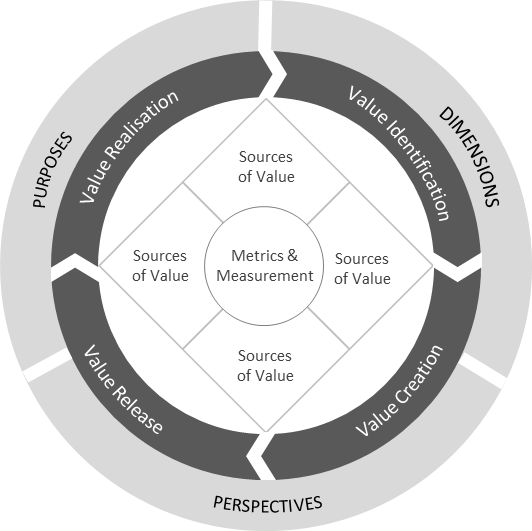
This framework shall enable us “define what we value as a business (Sources of value) from multiple stakeholders’ “perspectives” across multiple “dimensions” of value with clear indication on the “purpose(s)” of tracking & measurement across a “value lifecycle” appropriate for the organisation or endeavour at hand”.
Let’s now unpack the solution I suggested above:
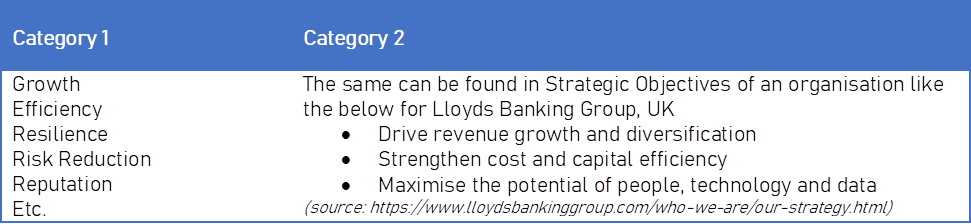
Sources of Value: At the core of an organisation’s economic-engine lies its sources of value, which are embedded in the organisation’s strategy and its offerings (propositions, products, services etc.) to the intended users. These sources reflect the unique capabilities, assets, or positions that an organisation leverages to generate economic benefits and stakeholder value. For example, a high street bank derives value primarily from the financial products it offers, such as savings accounts which attract capital and loans that generate interest revenue. Beyond these traditional sources, a bank might also find value in its customer relationships, brand reputation, technological innovation, and operational efficiency. Each of these components serves as a wellspring from which the bank can draw to sustain and grow its market presence. Typical sources of value would look like:
Metrics and Measurement: These sources of value are measured through various metrics. For a typical Bank, few metrics they measure could include “savings or mortgage balance, cost-income ratios, number of complaints, number of customer service calls” etc. There will be hundreds of such metrics you’d find in any organisation.
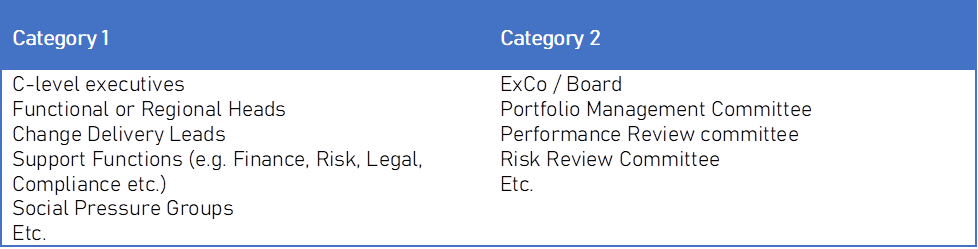
Perspectives of Value: (Business) Value is contextual. Value in an organisation is multifaceted and perceived differently across various levels and stakeholders. For example, C-Level Executive may prioritise strategic alignment and long-term returns, whereas Change Delivery Leads may focus on project feasibility, efficiency, and delivery within budget and time constraints. Sometimes, improving on one metric could adversely affect other critical metric, for example: increasing mortgages balance could be achieved at the expense of taking more risk. Recognising these diverse perspectives is crucial for holistic value management. It ensures that the organisation’s strategies and actions resonate with all stakeholders, aligning with their unique priorities and expectations. Typical perspectives you need to consider in an organisation are:
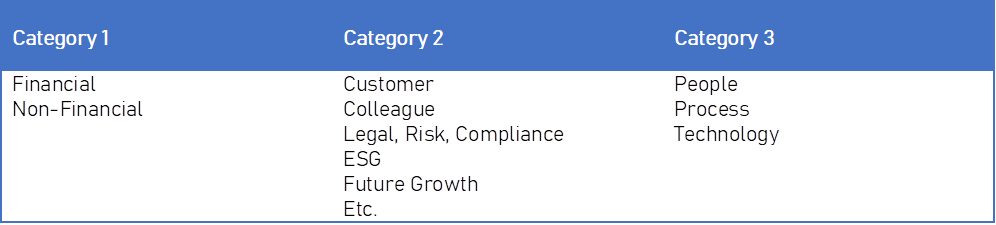
Dimensions of Value: The dimensions of a value are aspects of an organisation or programme or portfolio that are being evaluated. These dimensions are used to assess the effectiveness and success of the organisation or programme or portfolio. Organisations typically measure “financial” dimension of value. But this is not the only dimension that portfolio investments contribute to. Balanced Scorecard broadened these dimensions that many organisations are using for quite some time. Along with these, there are multiple categories of dimensions that organisations shall use. Table below summarises few such categories:
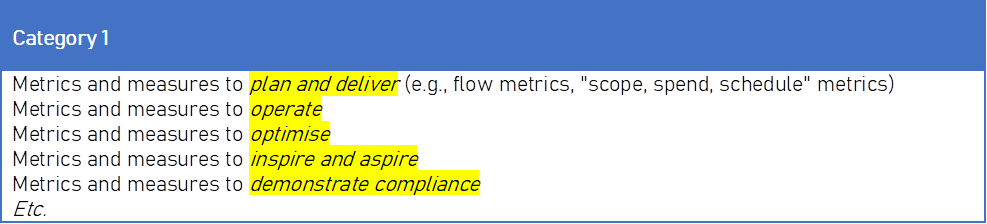
Purpose of Value Measurement: In Value Management, understanding the Purposes of Value Measurement is crucial. It defines the “why” behind the measurement process, directly impacting the “what” and “how” of data collection, analysis, and utilisation. An example from Agile-camps is “Team Velocity”. Though it is useful for team members, it is not meant to be used to compare how different teams are performing. Quite often, it is detrimental to change the purpose of measurement when making decisions. So, the “purposes of value measurement” help us determine what metrics and KPIs are being measured, how the data is being collected and analysed, and how the insights are being used. Typical purposes include:
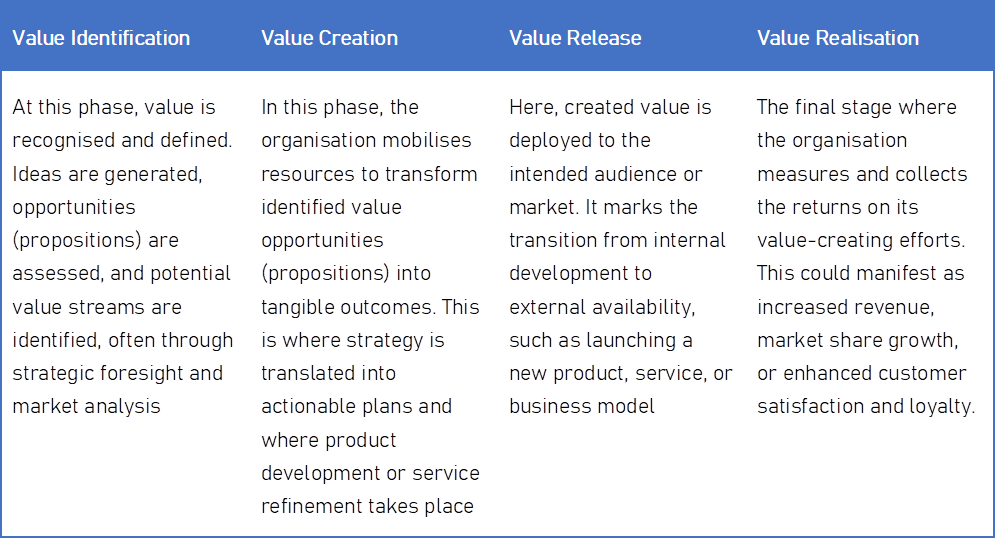
Value Lifecycle: Known by many names like “concept to cash and idea to impact”, a value lifecycle defines the stages within which an organisation manages and optimises the value it intends to create. The value lifecycle represents an organisation’s journey from the initial idea to its ultimate impact on the market and financial books, often spanning years in large organisations. Typical lifecycle stages are “Value Identification, Value Creation, Value Release and Value Realisation”. In many organisations, these are seen as “Strategic / Corporate Planning, Business & IT Solution Delivery, Operational Change, IT Operations & Business Operations (usually known as BAU, Run activities) etc.”.
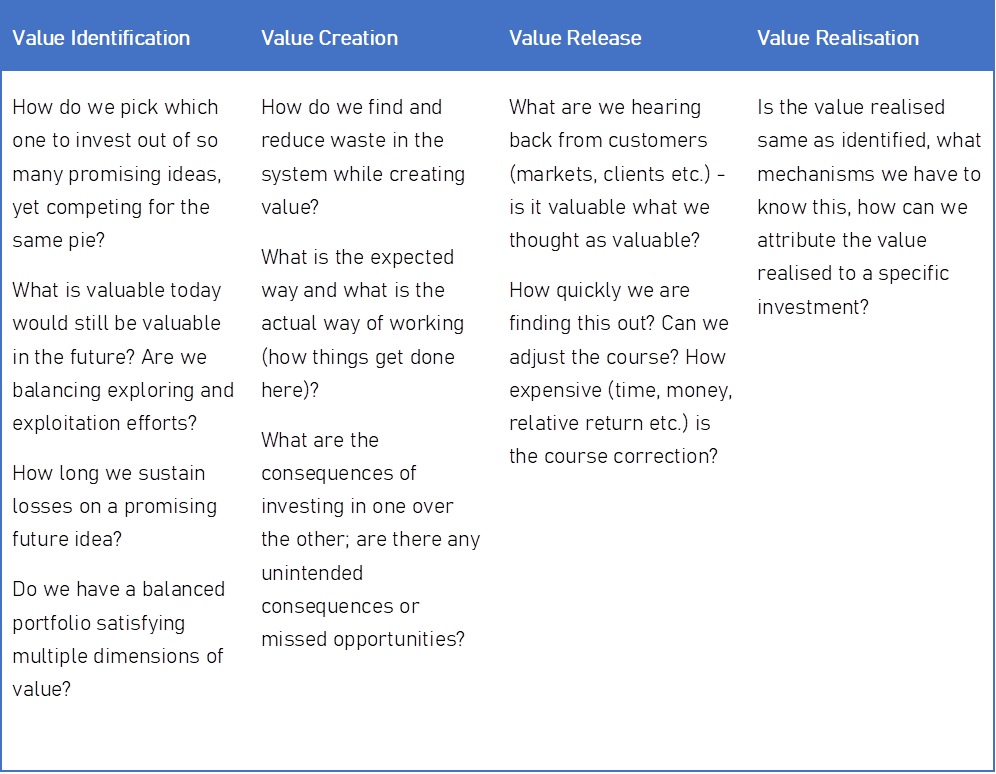
Few questions to ask across value lifecycle
Look at Value Lifecycle again. Value Identification and Value Creation happen in the strategy and change worlds. Projects, programmes, product development, proposition development, whatever you call it. Value Release is the handoff from the change world to business operations and more importantly to the end users. But Value Realisation? That happens overwhelmingly in operations. In the Run side, not change side.
Think about it. A project (not necessarily Tech change) team builds a new digital service or a new proposition. They launch it. The project closes. But the actual value, reduced call volumes, improved customer satisfaction, revenue from the new channel, all of that happens after the handoff, in business-as-usual. The operational teams, the customers, the end users are the ones who determine whether the capability that was built actually translates into returns.
Change teams build capability. Operations realise value from it. If your measurement stops when the project closes, you are measuring effort. You are not measuring value. "We track benefits of each project / programme / initiative" - you could say. But end users / market doesn't consume your offering project by project. The end user behaviour is result of hundreds of your own organisation's actions and all of your competitors, substitutes products / offerings and many many others. Benefits tracking for each initiative fails well short of understanding of the value realised.
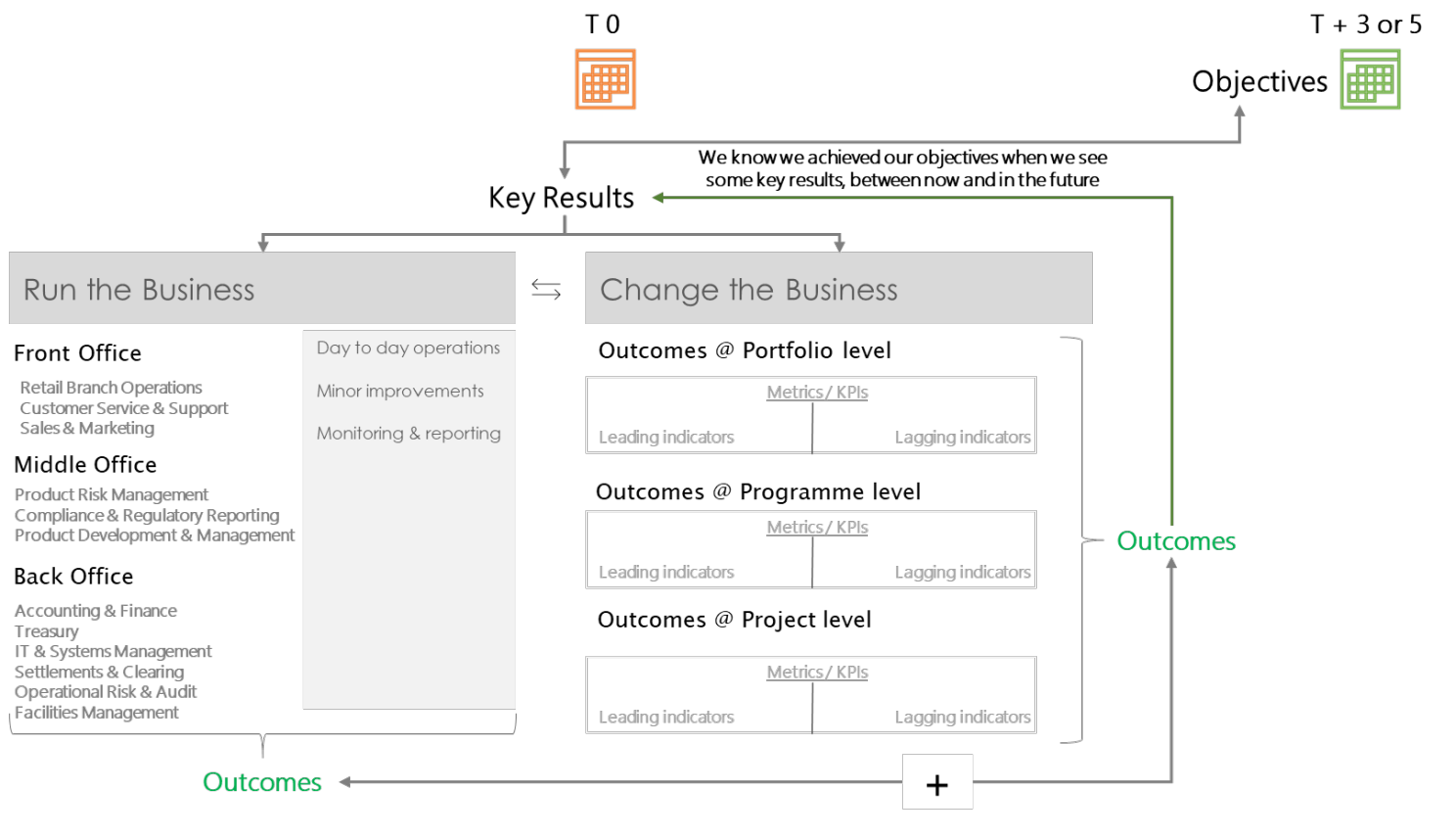
Quite often, value lifecycle stages are not sequential activities or stage gates, but typically overlapping activities yet distinct enough for us to act in a different way. These are not to be confused with Project delivery stages of software development lifecycles, though they can be mapped along these lines.
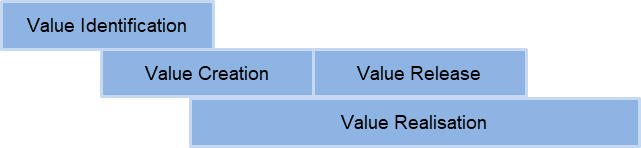
Not just the understanding of the nature of the value realisation, there are two other distinct challenges that organisations face - vertical alignment challenge and horizontal alignment challenge. Get one right while ignoring the other and you end up with a familiar failure pattern.
The first is vertical alignment. Can you trace a line from what your teams are doing today all the way up to the outcomes the organisation exists to achieve? This is the "value hierarchy" problem. At the top of the hierarchy sit long-term outcomes: market growth, customer trust, whatever your organisation's purpose demands. At the top layer these are often found in "Purpose, Vision, Mission, Strategy documents". Below those sit intermediate outcomes that contribute to the long-term ones. Below those sit the initiatives, programmes, and operational activities producing deliverables day to day - one could go all the way to a team's outcomes.
One thing to notice about this hierarchy. Attribution gets harder as you move up. At lower order, be at a team level or a function level you can say with confidence that Project X produced Output Y. As you move up the value hierarchy this becomes difficult. Multiple initiatives, external forces, market conditions, and stakeholder behaviours all contribute. This is where traditional benefits management falls over. It assumes a one-to-one mapping between a project and its benefits. At those top levels you need contribution logic: did this set of investments collectively move the needle on this outcome? That is a different question from "did Project X deliver Benefit Y?"
The second challenge is horizontal alignment. How does value mature over time? This is what the Value Lifecycle provides, explained above. It tracks the journey from idea to impact: Identification, Creation, Release, Realisation. Each stage has its own questions, its own governance needs, its own measurement requirements.
Neither of these works on its own. A clear value hierarchy without lifecycle awareness means you know what you're pursuing but you can't tell where in the journey each initiative currently sits. Lifecycle tracking without a hierarchy means you can report that an initiative is in "Value Release" but you can't say what strategic outcome it feeds.
Here is a diagrammatic representation of the elements when you put all those together:
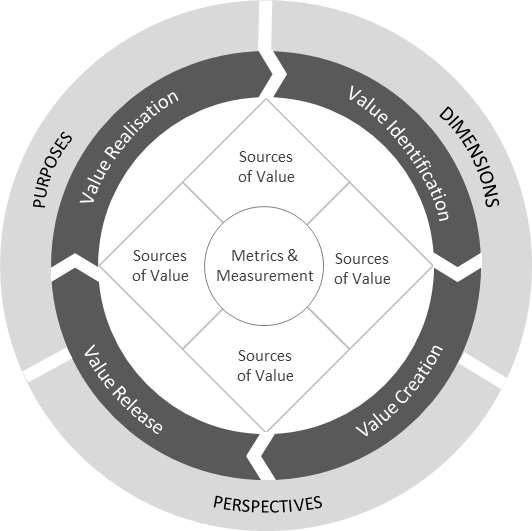
Value Management Framework – Artefacts and Use Cases
Apart from the conceptual understanding, such a framework shall provide “structure, processes, tools, and metrics” necessary to implement Value Management across the organisation.
In practice, this means putting a few things in place:
Value definition: A shared understanding of value grounded in what the organisation does and where it is heading. What are your sources of value? Which dimensions matter most? Whose perspective counts? What are you measuring and why? Without this, everyone uses the word "value" to mean something different, and the reports they produce answer different questions. The three lenses force that conversation: you define value across Sources, Dimensions, and Perspectives before anyone starts measuring anything.
Value assessment: How do you pick which initiatives to fund? Most organisations default to financial business cases or couple of other dimensions or gut feel. The framework uses a multidimensional prioritisation method (Alignment, Affordability, Achievability) with supporting tools. Initiatives are scored against agreed sources and dimensions of value. Governance panels include representatives from multiple perspectives.
Value Tracking: This is where a "measurement framework" sits inside the Value Management Framework. A few specific things live here. Tools for consistent definition of value across the hierarchy, metrics design, the concept of value drop, which underpins executive decision making, tools for clear attribution of value at lower order and establishing causal links as you move up the value hierarchy etc.
Governance structures & Decision Rights: Most governance forums review delivery status: RAG ratings, milestones, spend. The question "is this on track?" gets asked constantly. The question "is this still valuable?" rarely surfaces. The framework redesigns governance forums to ask both. It integrates Risks, Assumptions, Issues, Dependencies, and Decisions (RAIDD) across forums instead of letting them sit in silos. And it assigns decision rights so that the same conversation doesn't keep circulating between overlapping forums without anyone owning the call.
Strategy-to-execution translation: Your five-year strategy says "improve customer outcomes." What does that mean for next quarter? The framework uses IF → THEN → BECAUSE logic: IF we invest in this capability, THEN we expect this outcome, BECAUSE of these assumptions. This framing turns a strategic intent into a testable hypothesis. Teams can see how their work connects to strategy. Executive Leaders can see where the logic is strong and where it rests on assumptions that need watching.
Change-Run boundary management: When a project / programme finishes, someone needs to pick up or continue with the value tracking on the other side. Most organisations don't manage this handoff beyond service transitions, SLAs, ad hoc support etc. The framework defines explicit criteria for when value tracking responsibility transfers from the change portfolio to operational teams, and ensures measurement continues across the boundary. This is more than "benefits tracking for a project or programme".
Toolchain integration: In any large organisation you'll find Jira, ServiceNow, Planview, Azure DevOps, PowerBI, SharePoint, finance systems, HR systems. The framework maps your toolchain against the value hierarchy, distinguishing systems of engagement, systems of record, and systems of work. The question isn't "which tool is best?" It's "which integration points matter most for value data to flow without manual re-keying?"
The below diagram shows how the Value Management Framework comes to life for implementation on the ground (these are just a few out 30+ methods & tools the framework comes with):
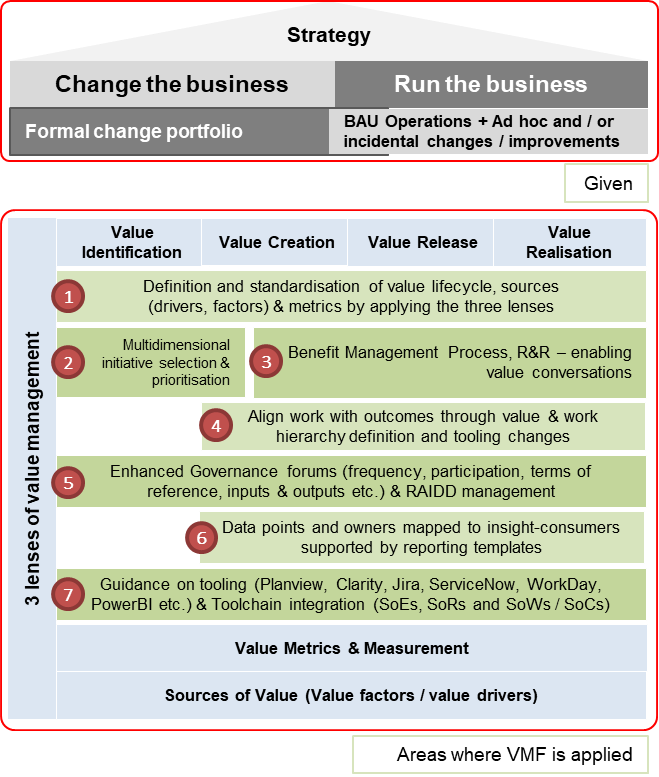
- Definition and standardisation of value lifecycle, sources (drivers, factors) & metrics by applying the three lenses
- Multidimensional initiate selection & prioritisation
- Benefit Management Process, R&R, Tooling – enabling value conversations
- Align work with outcomes through value & work hierarchy definition and tooling changes
- Enhanced Governance forums (frequency, participation, terms of reference, inputs & outputs etc.) & RAIDD management
- Data points and owners mapped to insight-consumers supported by reporting templates
- Guidance on tooling (Planview, Clarity, Jira, ServiceNow, WorkDay, PowerBI etc.) & Toolchain integration (SoEs, SoRs and SoWs / SoCs)
How does this solve the challenges?
The terminology challenge: "outcome" means one thing to the strategy team and something else to the delivery lead. #1 (definition and standardisation) tackles this directly. Organisation gets behind a small set of terms and what they mean in various contexts. You embed them in governance terms of reference, portfolio & BAU reporting templates, reporting formats. #6 reinforces it by mapping data to the people who consume it, in the language they've agreed to use.
The translation challenge: the strategy document lives in one world, the project portfolio in another that all converge at operations. #4 (aligning work with outcomes through the value hierarchy) builds the connective tissue. IF → THEN → BECAUSE logic from #1 makes the strategy-to-execution link visible and testable. When an initiative can trace a line from what it delivers to which outcome(s) it feeds, the portfolio stops being a collection of disconnected projects / programmes.
What about the downstream effects visible in the causal loop? #2 stops low-value work entering the portfolio. #3 creates recurring conversations about whether investments are still worth pursuing, mid-flight, not just at approval (pause, pivot, persevere decisions). #5 reduces the governance overhead by eliminating overlapping forums and clarifying who decides what. #7 makes value data flow through the tools teams already use, reducing the manual effort that produces hundreds of reports nobody reads.
These seven areas are the ones visible in this article. Behind them sit 30+ methodologies, methods and tools grouped across four themes:
- establishing shared meaning (Value Coherence),
- enabling value to move from idea to impact (Value Flow),
- making value visible for decisions (Value Evidence), and
- providing the organisational scaffolding for practices to persist (Value Enablement)
The visual below highlights areas where framework elements could help address the complex challenges (numbers below map to the numbers in the above diagram):
For the practically minded
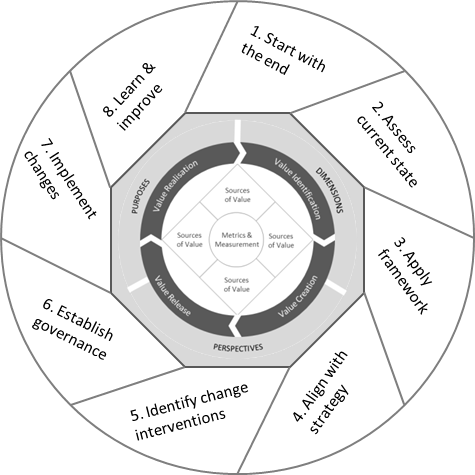
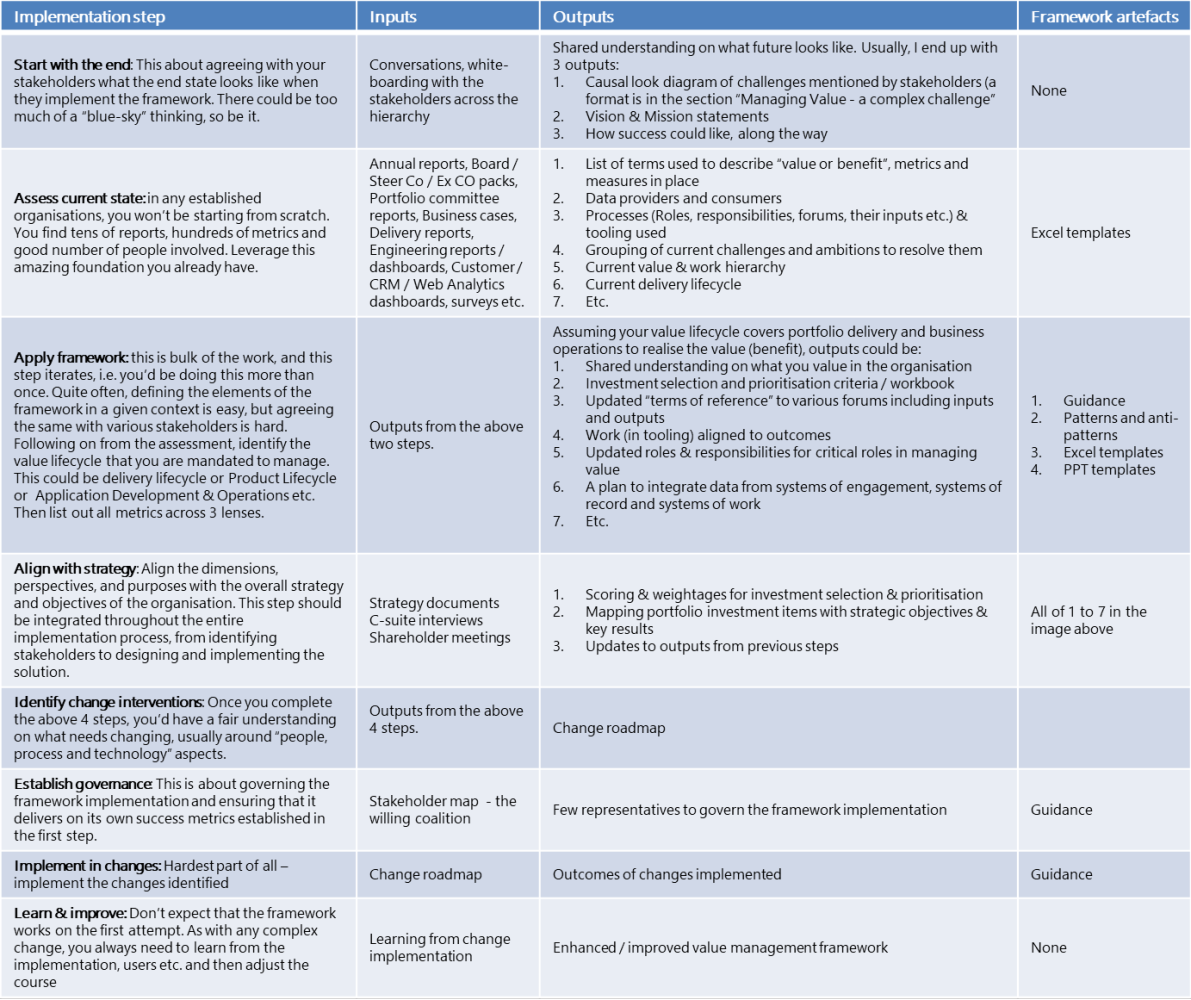
If you are convinced of the argument above and want to get going, below are the DIY implementation steps (loosely based on Deming’s Cycle – PDSA):
For the academically minded
Value: The perceived benefits, usefulness, and importance of something. In the context of “funded project portfolio”, “value” refers to the tangible and intangible worth of a project or portfolio delivers to the organisation and its stakeholders. Value is the primary reason organisations invest in projects, programmes and other activities.
One of the earliest known definitions of Value comes from Daniel Bernoulli, who stated that “value of an item must not be based on its price, but rather on the utility which it yields“. Much of the current thinking (definitions, processes, tools etc.) come from Lawrence D. Miles, an electrical engineer with General Electric (GE), who took a “function” view for the utility. This can be seen in "Society for American Value engineers (SAVE), The Institute of Value Management" etc.
In my view value is more than “functional utility”. The 'function' view from Miles and SAVE is useful for product and service design but too narrow for organisational value management. The same goes for the widely used OGC (UK) formula. Though further explanation, in the guidance, goes beyond this formula, this has many issues embedded in it, like
- Satisfaction of requirements is not same as "benefits"
- Increasing satisfaction of requirements may not always increase value
- "Value" is more than just "benefits and expenditure"; see "my view of value" below
- etc.

My view of "value":
- Value is co-created. Both Producers and Consumers are required in order to create value. This has direct consequences for how we design measurement and governance. (See further explanation at the end of the article)
- Alignment with strategic intent / direction & coherence at aggregate: Value is inherently tied to the strategic objectives of the organisation. Value includes benefits but also considers a) cost of achieving those benefits, b) alignment with strategic objectives and c) Coherence when aggregated. This "coherence" is another nuance here, the "coherence" of "what we value" at an organisational level when aggregating all of the work could be fundamentally different to "value of an individual change initiative". Three programmes in a portoflio may be delivering benefits they promised but could be cannibalising each other's benefits.
- Value is subjective: Two people looking at the same initiative will assess its value differently. A finance director sees cost and its recovery. A customer experience lead sees satisfaction scores. A compliance officer sees risk reduction. None of them are wrong. This framework insists on multiple perspectives and why a metric could be a number or a narration. Pure objectivity is not always possible when the thing you are measuring depends on who is doing the measuring and more importantly the purpose of such measurement.
- Value is contextual / context sensitive: The same initiative can be highly valuable in one setting and worthless in another. A digital self-service platform creates enormous value for an organisation with high call volumes and long wait times. For one with low volumes and a customer base that prefers phone contact, the same platform creates very little. Context includes market conditions, organisational maturity, stakeholder readiness, timing, and competitive landscape. This framework doesn't impose universal scoring models, maturity assessments on someone else's scale and instead asks you to define your own sources and dimensions of value before measuring anything.
- Value is the “underlying context for decision making”: Every investment decision, every prioritisation call, every "should we continue or stop?" conversation is a value judgement, whether the organisation recognises it or not. When an ExCo approves a programme, they are making a claim about value. When a governance forum cancels one, same thing. The framework makes these value judgements explicit and structured rather than implicit and political. Instead of decisions being justified after the fact, the value logic is stated upfront: IF we invest in this, THEN we expect this outcome, BECAUSE of these assumptions. That makes the decision challengeable, testable, and improvable over time.
Value Management: The systematic approach to aligning work / activities across the organisation to maximise their contribution to the strategic intent (goals, objectives, outcomes, aims, vision, mission, purpose etc.).
Value Management Framework: provides the structure, processes, tools, and metrics necessary to implement Value Management across the organisation.
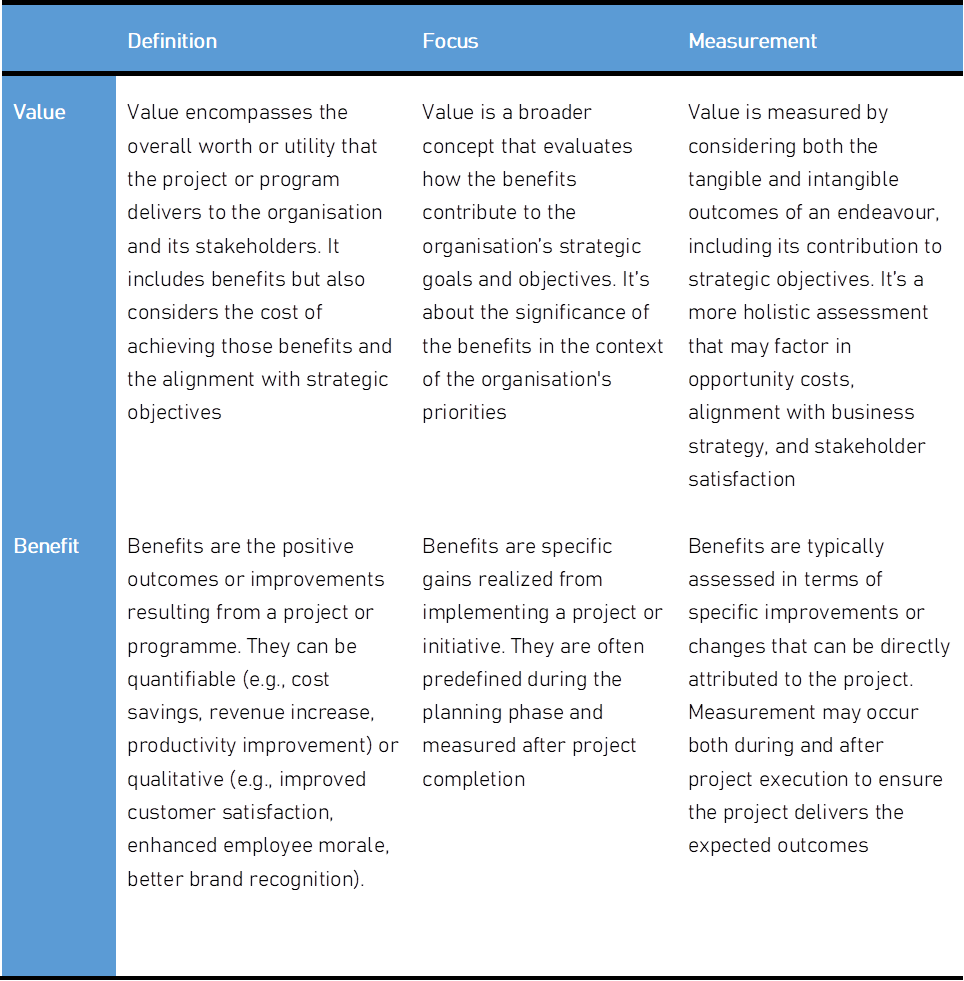
Value vs Benefit: In the context of Project-Portfolio Management and Value Management, there is a distinction between “value” and “benefit,” though the two terms are closely related and often used interchangeably. See table below for further explanation.
Other popular frameworks dealing with Value and/ Or Performance
DuPont Model: The DuPont Model, also known as the DuPont Analysis, is a financial performance framework that breaks down Return on Equity (ROE) into three components: profit margin, asset turnover, and financial leverage. This helps businesses understand how their operations, asset management, and financial structure impact their overall performance.
The Results and Determinants Framework: The Results and Determinants Framework is an approach that focuses on identifying the key drivers (determinants) of organisational performance and the expected results. It helps organisations understand the causal relationships between performance drivers and outcomes, thus enabling better decision-making and resource allocation
The Performance Measurement Matrix: The PMM was developed by Keegan et al. (1989). It integrates financial and non-financial internal and external facets of business performance. The main strengths of PMM are its simplicity and integrated structure. The main criticisms of PMM include a lack of structure and detail, particularly in relation to making the links between different business dimensions more explicit, as in the Balanced Scorecard
The Strategic Measurement Analysis and Reporting Technique (SMART): SMART is a performance management framework that emphasizes the development of clear objectives, consistent metrics, and regular reporting. It encourages organizations to set specific, measurable, achievable, relevant, and time-bound (SMART) goals, making it easier to track progress and make informed decisions
Integrated Performance Measurement System Reference Model (IPMS-RM): The IPMS-RM is a conceptual model that provides a framework for designing, implementing, and maintaining an integrated performance measurement system. The model emphasizes the alignment of performance measures with strategic objectives and the integration of various performance measurement tools and techniques.
Balanced Scorecard: The Balanced Scorecard (BSC) is a strategic performance management and measurement framework developed by Dr. Robert Kaplan and Dr. David Norton. It helps organizations translate their strategic objectives into a set of performance indicators that can be monitored and managed. The BSC is built around four key perspectives: financial, customer, internal processes, and learning & growth. By incorporating both financial and non-financial measures, the Balanced Scorecard provides a more comprehensive view of an organization’s performance and encourages a focus on long-term success
The Business Excellence Models of the European Foundation for Quality Management (EFQM): The EFQM Excellence Model is a framework for assessing and improving organizational performance. It consists of nine criteria: five “Enabler” criteria (leadership, people, strategy, partnerships & resources, and processes) and four “Result” criteria (customer results, people results, society results, and business results). The model encourages a focus on continuous improvement and stakeholder satisfaction
The Value Measuring Methodology by Booz, Allen, Hamilton: Ground breaking for its time and far ahead. One can really the see the makings of Lean Portfolio Management, popularised by SAFe decades later.
Information Paradox by Fujitsu Consulting: One of the core works from which I learned the concepts like "Value Drivers, Value Management Office, Value Cases" etc.
Value is c-created
An organisation can build a product, design a policy, or deliver a service. But if the intended audience doesn't adopt it, engage with it, or change their behaviour because of it, no value has been created. The organisation creates conditions for value. The other party has to show up.
Apple crafted "Newton" well. But the customer / market isn't ready. Governments across the world have invested in planned cities. Well-designed, infrastructure-ready, built to solve housing crises. Some remain largely unoccupied. Citizens didn't choose to move there. Everything on the supply side was done right. The demand side didn't participate.
This is why the framework includes Perspectives of Value as one of its three lenses. Different stakeholders experience different aspects of the value an organisation creates. The C-suite could see strategic alignment. The delivery team may be interested in execution quality. The customer sees whether their life got better. "Who determines whether value has been created?" doesn't have a single answer. It depends on whose perspective you are measuring from, and at which level of the value hierarchy you are looking.